Welder jobs in Australia for Nigerians: 6 things to sort out at home before you japa
Tips · 2026-10-28 · 10 min read
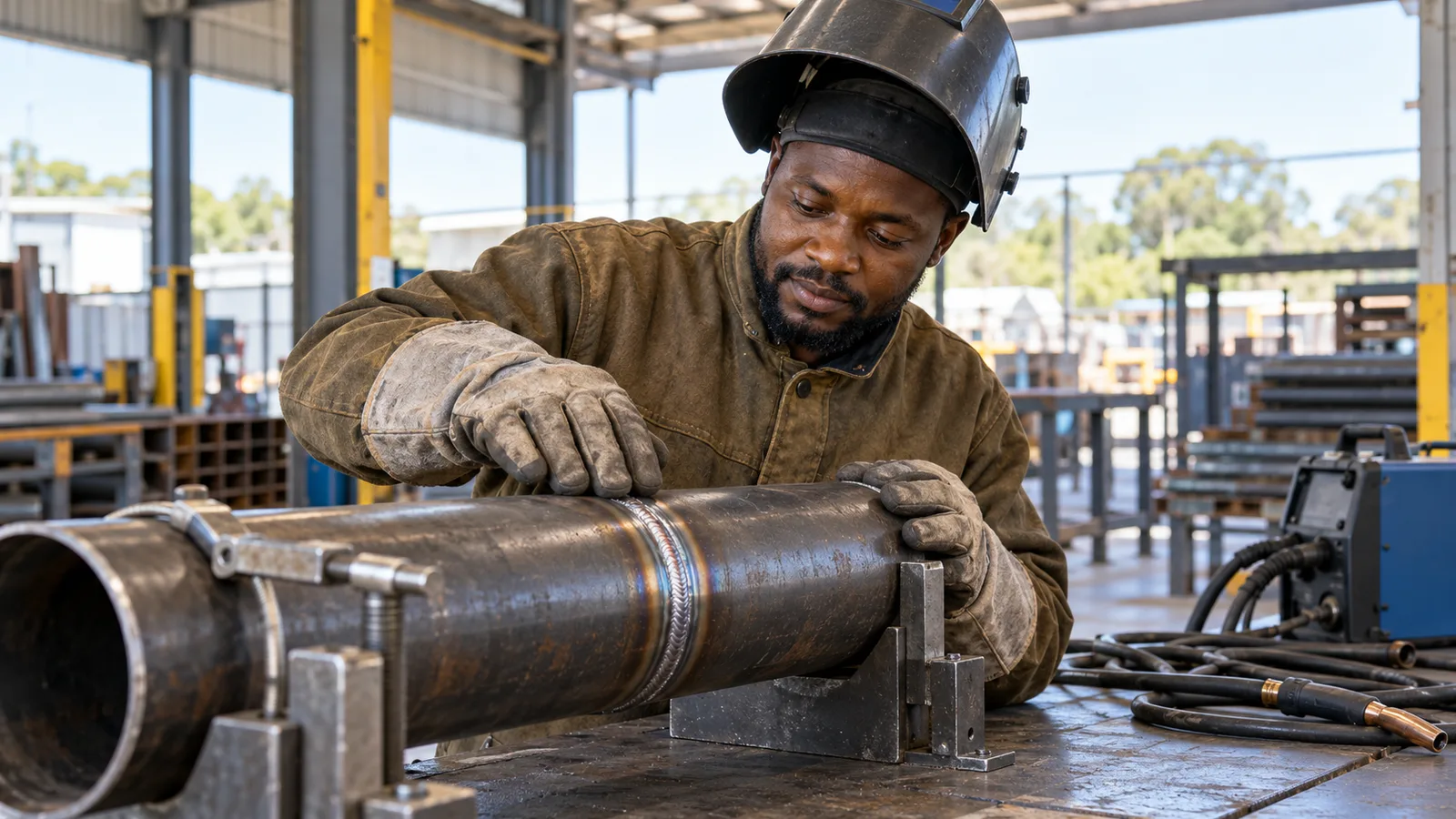
Welder jobs in Australia for Nigerians come through an employer who sponsors you, usually on the Skills in Demand visa (subclass 482), and that employer will only move once your paperwork can carry the visa. The good news: almost everything that slows a welder down can be prepared from Nigeria, before any interview. This guide sets out the six things to have ready, in the order to do them, if you are welding in Warri, Port Harcourt, Onitsha or Lagos today.
If you read our earlier post on Australia's shortage of qualified welders, you already know the demand side. This one is about your side.
The six-part folder every Nigerian welder should build
Think of it as one folder, paper and scanned, that a sponsor, an assessor and Home Affairs can each understand without phoning you.
| Part of the folder | What it proves | Where you get it |
|---|---|---|
| Occupation title check | Which welding-related title fits your real work, its list status and its assessing authority | Home Affairs' combined list of eligible skilled occupations |
| Work evidence | At least 1 year of relevant experience in the last 5 years, with the tasks you did | Employers, contractors, your bank, your own records |
| Skills assessment | That your skills meet the Australian standard for the occupation | The authority named on the list, often Trades Recognition Australia (TRA) |
| English test result | Your English meets the 482 minimum | An accepted test taken at a test centre, not online at home |
| Police Character Certificate | Your criminal record status in Nigeria | Nigeria Police Force, through the POSSAP portal |
| Visa medical | You meet the health requirement | A Home Affairs panel clinic in Lagos, Abuja or Enugu |
Our checklist of documents needed to relocate to Australia from Nigeria covers the passport and other papers around this folder.
Pick your welding title before you collect a single letter
In a fabrication yard at home, the same person may weld pipe in the morning, cut and fit plate after lunch and service a machine at night. An Australian sponsor cannot nominate "all-round welder". They nominate one occupation, and your evidence has to match it.
Open the combined list of eligible skilled occupations and search welder, metal fabricator and fitter. For each title, the list shows whether it sits on the Core Skills Occupation List (CSOL), the MLTSSL, the STSOL or the Regional Occupation List, and it names the assessing authority. Write those down.
Then be honest about your hours. If most of your work was pipe and structural welding, pick the welding title. If you spent more time on marking out, cutting and assembling steel, a fabrication title may fit your evidence better. Live roles show how employers word these jobs: our fabricator welder role in Perth is a good one to read line by line, and the manufacturing jobs page lists related openings.
Turn yard work into evidence an assessor can read
Welding in Nigeria is often paid by the job, the day or the contract. Oil and gas yards in the Niger Delta use contractors and subcontractors; roadside workshops in Aba or Onitsha may have no payroll at all. That experience is real, but an assessor only sees paper.
Trades Recognition Australia describes its Migration Skills Assessment as a documentary assessment: it compares your qualifications and employment history with Australian standards. So the job now is to make your history readable.
What to collect from each employer or contractor
- A letter on headed paper with your full name as it appears on your international passport, your job title, start and end dates, hours per week and a clear list of the welding tasks you did.
- Proof you were paid: bank statements with regular credits, pay slips or tax records, whichever exists.
- Dated photos of your work in progress and finished joints, where the site allows photos.
- Any trade test, welding certificate or technical college result, with WAEC or NECO results ready for verification. NECO e-Verify is the exam body's own online service for checking results.
Anything not in English must be translated, and both the original and the translation provided. A translator outside Australia does not need to be accredited, but must include their full name, address, phone number and language qualifications and experience.
Our guide to carpenter jobs in Australia for Nigerians goes deeper on reference letters for cash-paid and self-employed work; the same method works for welders.
Skills assessment: the step that can make or break the visa
For some 482 applicants a skills assessment is mandatory. It is done by Trades Recognition Australia or VETASSESS, depending on the occupation, and it must be started before the visa application is lodged, or the application is not valid. It must also have been started or completed within the 3 years before you apply.
Read the TRA Migration Skills Assessment page before you pay anything, and check that the authority named for your title on the Home Affairs list is the one you apply to: Home Affairs only accepts an assessment from the relevant authority, and each authority has its own procedures, timeframes and charges. An assessment with no validity period shown is valid for 3 years from the date of issue.
One thing a positive result does not do: TRA does not award Australian qualifications, registrations or licences. Once in Australia, some experienced workers look at a formal qualification as well. RPLDirect's page on the Certificate III in Engineering - Fabrication Trade shows how that trade qualification is structured.
What a sponsor must pay, in dollars and roughly in naira
In the 482 Core Skills stream, the employer pays the Annual Market Salary Rate for the occupation and no less than the Core Skills Income Threshold. That threshold is AUD79,423 a year for nominations lodged between 1 July 2026 and 30 June 2027.
As a rough comparison only, that is about N73,480,000 a year, using the official US dollar rates of 16 October 2026 (the RBA's 0.6947 US dollars per Australian dollar and the CBN's central rate of 1331.7582 naira per dollar). Rates change, so treat it as a sense of scale, not a budget.
Award minimums also apply. Under the Manufacturing and Associated Industries and Occupations Award 2020, the C10/V5 trade level has a minimum of $1119.10 a week or $29.45 an hour from 1 July 2026; check which award covers the actual job. Visa holders have the same workplace rights as every other employee, including pay, leave and final pay.
English test, police certificate and medical: timing from the South-South
These papers expire, so order matters.
English test
For the 482 Core Skills stream, IELTS Academic or General Training needs at least 5.0 in each of listening, reading, writing and speaking. PTE Academic needs Listening 33, Reading 36, Writing 29 and Speaking 24. The test must be taken within 3 years before you apply, and tests taken entirely online at home are not accepted. Short daily practice on PractiseNow can help you see which section needs the most work before you book a centre.
Police Character Certificate
The Nigeria Police Force issues the Police Character Certificate under the seal of the Inspector-General of Police. You apply through POSSAP with your NIN or BVN, attend biometric capture, and the NPF states it takes 5-7 working days from complete documents. Australian police certificates are valid for 12 months from issue, so request it when a sponsor is serious, not a year early.
Visa medical
Home Affairs lists panel physicians in Nigeria only in Lagos, Abuja and Enugu, so a welder in Warri or Port Harcourt should plan the trip. You need a HAP ID to book, and 482 health results are generally valid for 12 months. Our list of approved visa medical clinics in Nigeria has the names and areas.
Your plan, step by step
- Search the combined occupation list and choose the one welding-related title your evidence supports. Note its list and assessing authority.
- Collect employer letters, payment proof and dated work photos for every job in the last 5 years.
- Get school and trade results ready for verification, and arrange translations where needed.
- Write a one-page CV that leads with your welding processes, positions and materials. Build AI CV can help you lay it out the way Australian employers read CVs.
- Book an English test at a centre and practise the weakest section first.
- Apply only to genuine sponsored roles and read our 482 visa guide so you understand what your employer lodges and what you lodge.
- Once an employer confirms, start the skills assessment with the named authority before the visa is lodged.
- Request the Police Character Certificate and book the panel medical so both are fresh at lodgement.
- Lodge through ImmiAccount, the only official website for Australian visa applications, and later check your grant in VEVO.
Welders in other countries are working through the same steps. JobsAbroad Bangladesh's piece on welders and fabricators eyeing Australia is a useful outside view.
Common mistakes Nigerian welders make
- Paying for a "sponsorship slot". It is illegal for a person to pay an employer to sponsor them, including through salary deductions. It can lead to visa refusal or cancellation, fines or imprisonment. The EFCC is blunt too: no credible employer demands pre-employment payments.
- Trusting a "work permit" offer. Australia does not issue work permits, so anyone selling one is running a scam.
- Using an unlicensed agent. Check any recruiter on the NELEX list of accredited private employment agencies, as our guide to checking if a recruitment agency is licensed explains. Anyone giving visa help must be a registered migration agent, a lawyer or an exempt person.
- Letters that say "welder" and nothing else. An assessor needs dates, hours and tasks, not a title.
- Getting the police certificate too early. Twelve months goes fast while you wait for an offer.
- Taking an online English test at home. Home Affairs does not accept tests delivered entirely online.
Frequently asked questions
Is welding on the list of occupations Australia sponsors?
Check the combined list of eligible skilled occupations on the Home Affairs website. Search for welder, metal fabricator and fitter titles, and note for each one which list it sits on and which body assesses it.
Can I start my skills assessment from Nigeria?
Yes. Trades Recognition Australia runs documentary assessments for applicants overseas, comparing your qualifications and employment history with Australian standards. Where an assessment is mandatory for the 482, it must be started before the visa application is lodged.
How much must a sponsored welder be paid in Australia?
In the 482 Core Skills stream the employer must pay the market salary for the role and no less than AUD79,423 a year for nominations lodged from 1 July 2026. Award minimums also apply, and visa holders have the same workplace rights as other employees.
Where do Nigerian welders do the visa medical?
Only at a clinic on the Home Affairs panel list, which has panel physicians in Lagos, Abuja and Enugu. You need a HAP ID to book, and results are generally valid for 12 months for the 482.
Should I pay an agent who says they can get me a welding job and visa?
No. Paying an employer or anyone else for visa sponsorship is illegal and can lead to refusal, cancellation, fines or prison. Check any recruiter on the NELEX list and any visa helper on the official register of migration agents.
Key takeaways
- A sponsoring employer is the route; your job is to make your welding experience easy to check.
- Choose one occupation title from the Home Affairs list and match every letter to it.
- Start any mandatory skills assessment before the visa is lodged.
- Time the police certificate and medical so neither expires before lodgement.
- Never pay anyone for sponsorship, a job or a "work permit".
#welder jobs in australia #welding #japa #skills assessment #482 visa #trades #nigerians
 Bricklayer jobs in Australia for Nigerians: what your block work proves, and what to learn first
 Carpenter jobs in Australia for Nigerians: turn your site experience into proof an assessor accepts
 Chef jobs in Australia for Nigerians: the 5 checks a sponsoring kitchen runs before it says yes